A supportive and celebratory process
External verification is the final stage of the National Quality Mark for SMSC and British Values.
It provides an opportunity for your school to celebrate its achievements, discuss its self-evaluation with an experienced verifier and identify priorities for continued development.
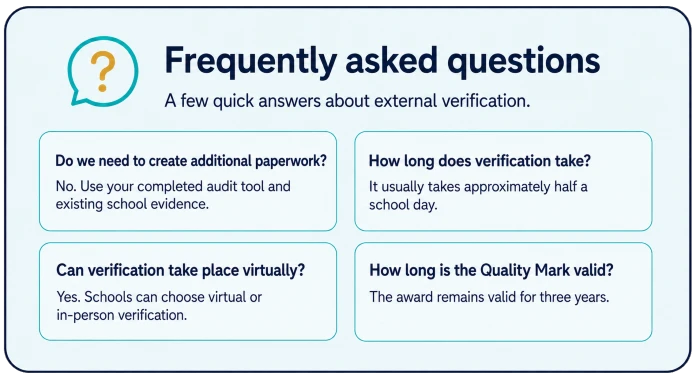
Verification is not an inspection, and schools are not expected to prepare large amounts of additional paperwork. It is a supportive professional conversation based on your completed audit tool, the evidence already available within your school and the experiences of your school community.

Before verification
Once your school has completed the SMSC and British Values Audit Tool, you can apply for external verification.
You will be allocated an experienced verifier who will:
- make initial contact with your SMSC lead;
- agree the date and format of the verification;
- provide a suggested timetable;
- review your completed audit tool and supporting information;
- identify any areas requiring clarification; and
- answer questions about the process.
The timetable will be agreed with your school and adapted to reflect its size, phase and context.
What happens during verification?

Verification usually takes approximately half a school day, although arrangements may vary according to the size and context of the setting.
The verifier will explore how SMSC development and fundamental British values are understood, experienced and embedded across the school.
- a pupil-led tour of the school;
- discussions with senior leaders and the SMSC coordinator;
- conversations with pupils and staff;
- meetings with governors, trustees or parents;
- consideration of curriculum planning and pupils’ work;
- observation of relevant lessons, assemblies or enrichment activities; and
- discussion of the school’s strengths and priorities for development.
Not every activity or stakeholder group will be required. The programme will be agreed in advance and designed around your school.
The pupil-led tour
The pupil-led tour is often one of the highlights of an in-person verification.
It allows pupils to explain what is important to them and helps the verifier understand the school’s culture, relationships, learning environment and sense of community.
The tour is not intended to showcase a perfect school. It provides an authentic opportunity for pupils to talk about their experiences and the ways in which SMSC and fundamental British values shape school life.
What evidence is required?
The emphasis is on the quality and impact of your school’s provision—not the quantity of paperwork produced.
The verifier will normally consider:
- the completed audit tool;
- relevant school policies and improvement plans;
- curriculum plans and examples of pupils’ learning;
- evidence of pupil leadership and participation;
- information about enrichment, partnerships and community engagement;
- the views and experiences of pupils, staff, leaders and governors; and
- evidence demonstrating the difference the school’s provision makes.
Schools should use existing evidence wherever possible. There is no expectation that additional documents will be created solely for verification.
Evidence may be provided electronically or made available during the verification.
Professional conversations
Conversations with members of the school community are an important part of verification.
They are intended to explore and clarify the school’s self-evaluation, rather than to test individuals or catch anyone out. Participants are not expected to rehearse answers.
The verifier may speak with:
- pupils;
- teachers and support staff;
- senior and pastoral leaders;
- the SMSC coordinator;
- governors or trustees;
- parents or carers; and
- other members of the school community where relevant.
The groups involved will depend on the context of the school and the evidence being explored.
Virtual or in-person verification
Schools can choose either virtual or in-person verification.
Virtual verification

Virtual verification is conducted through Microsoft Teams or another agreed secure platform.
Documents can be shared electronically, and conversations with leaders, staff, pupils, governors and other stakeholders take place online. Schools may also use photographs, recorded pupil tours or other existing digital evidence to illustrate their provision.
In-person verification

An in-person visit enables the verifier to experience the school’s culture and environment directly. It normally includes a pupil-led tour alongside professional conversations and consideration of relevant evidence.
Both formats follow the same framework and quality-assurance principles. Schools can achieve any award level through either format where the evidence supports that judgement.
In-person verification is charged at the standard verification fee plus agreed travel expenses.
Who are our verifiers?
Our verifiers are experienced education professionals with expertise in school leadership, SMSC, fundamental British values, personal development, PSHE and citizenship.
They understand the opportunities and pressures schools face and approach verification with professional curiosity, respect and integrity.
The verifier’s role is to:
- evaluate the school’s self-assessment fairly;
- recognise and celebrate effective practice;
- explore the impact of provision;
- provide constructive professional challenge; and
- identify helpful priorities for continued improvement.
How is the award level determined?
The verifier considers the school’s self-evaluation alongside the evidence gathered during verification.
The award level reflects the consistency, quality and impact of provision across the eight standards:
| Award level | Description |
| Bronze | Established provision |
| Silver | Evolving towards exemplary provision |
| Gold | Exemplary provision |
| Platinum | Consistently exemplary and sustained provision |
The final award is based on the overall strength of the evidence rather than on any single document, conversation or activity.
What happens afterwards?
Following verification, your school will receive:
- confirmation of the outcome;
- a written verification report;
- recognition of key strengths;
- recommended priorities for continued development;
- an electronic certificate; and
- the appropriate Quality Mark logo for use during the award period.
The National Quality Mark remains valid for three years, subject to the terms of the award.
If the evidence does not support the level identified through the school’s self-evaluation, the verifier will explain the judgement and provide constructive guidance on the next steps.
Ready to arrange verification?
If you have completed the audit tool and would like to arrange external verification, please contact us.
Testimonial from Hopefields School, 12th June 2026:
‘Had the most amazing assessment day with Sandra yesterday, she totally ‘got’ our school and gave us support and guidance on how to improve our offer, whilst celebrating all that we do well. Thank you! We would urge organisations to go through the audit – a useful self evaluation tool that makes you really think about next steps 🥇’